Home > Destinations > Flinders Ranges
Flinders Ranges
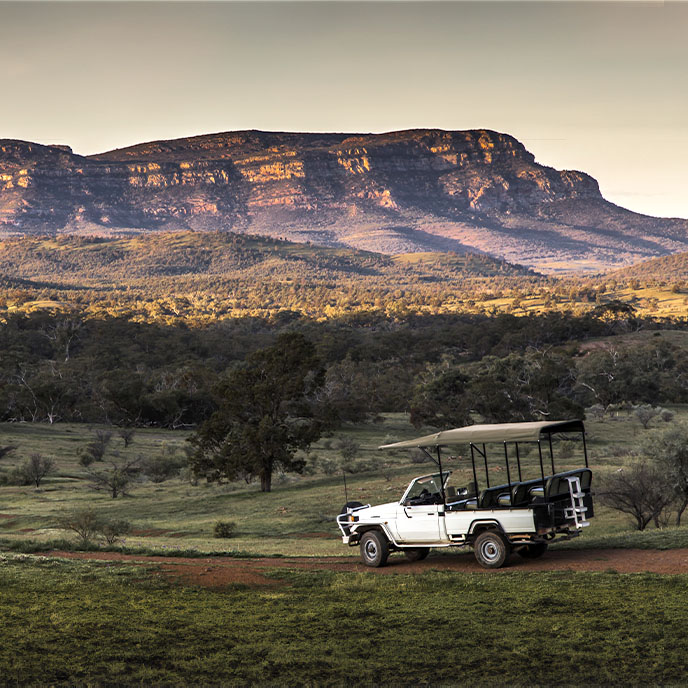
The Flinders Ranges is the largest mountain range in South Australia and stretch for over 430 km. Its most characteristic landmark is Wilpena Pound, a large, sickle-shaped, natural amphitheatre covering nearly 80 square kilometres, containing the range's highest peak, St Mary Peak (1170m), and adjoining the Flinders Ranges National Park.
An ancient landscape moulded by hundreds of millions of years of geological activity, the Flinders Ranges offers some of Australia’s most spectacular outback scenery.
Aborigines have lived in the Flinders Ranges for tens of thousands of years. For the Adnyamathanha - the hills or rock people, the ranges are still of immense cultural significance. While geologists use science to explain the formation of the Flinders, the Adnyamathanha people understand the land through their Yura Muda stories, which endow the physical features of the ranges with spiritual meaning and offer their own creation histories for the land and the life it supports. The creation histories and geology complement each other, enriching our knowledge of the landscape.
Scientists believe that the Flinders Ranges began to form about 800 million years ago when a great depression, known as the Adelaide Geosyncline, developed as the earth's crust stretched and thinned. The sea flooded in and, for 300 million years, huge amounts of rock debris, stripped from the land was deposited in the deepening depression to thicknesses of many kilometres.
About 500 million years ago the rock layers were squeezed and folded into a long mountain chain, much higher than today's ranges. The great bulk of the ancestral Flinders Ranges was then eroded over millions of years. Resistant quartzite now forms the highest peaks and ridges of the Flinders Ranges while the softer mudstone, siltstone and shale have been worn away to form valleys and gorges. Occasional earth tremors today indicate that the mountains continue to be uplifted.
In the Adnyamathanha Yura Muda, the unformed land was shaped by the Akurra, an immense maned and bearded water snake. Two Akurras, a male and a female, feature in the creation history for Wilpena Pound while the regions earth tremors are explained as rumblings from Akurra's water-filled belly. The activities of travelling ancestral spirits further shaped the land. The White-winged Fairy-wren threw a boomerang which created the cleft in Mount Chambers. An argument between a Euro and a Red Kangaroo led to the creation of the rocky northern Flinders Ranges, separated from Lake Frome by the sweep of the kangaroo's tail. Waterholes and springs along the eastern side of the ranges were created by the Thumping Kangaroo. Land, rocks and minerals are all manifestations of the Yura Muda.
Flora and Fauna
The flora of the Flinders Ranges is comprised largely of species adapted to a semi-arid environment such as sugar gum, cypress-pine, mallee, and black oak. Moister areas near Wilpena Pound support grevilleas, Guinea flowers, lilies and ferns. Reeds and sedges grow near permanent water sources such as springs and waterholes.
Bird life is rich and varied in the park, with more than 100 native bird species recorded.
Since the eradication of dingos and the establishment of permanent waterholes for stock, the numbers of red kangaroos, western grey kangaroos and euros in the Flinders Ranges have increased. The yellow-footed rock-wallaby, which neared extinction after the arrival of Europeans due to hunting and predation by foxes, has now stabilized. Other endemic marsupials include dunnarts, planigales and echidnas. Insectivorous bats make up significant proportion of mammals in the area. There are a large number of bird species including parrots, galahs, emus, the wedge-tailed eagle and small numbers of water birds. Reptiles include goannas, snakes, dragon lizards, skinks and geckos. The streambank froglet is an endemic amphibian. The Flinders ranges National Park is one of the best parks in Australia to view these unique animals.
The first humans to inhabit the Flinders Ranges were the Adnyamathanha people (meaning ‘hill people’ or ‘rock people’)[2] whose descendants still reside in the area. Cave paintings, rock engravings and other artifacts indicate that the Adnyamathana people have lived in the Flinders Ranges for tens of thousands of years.
Flinders Ranges National Park
Rugged mountain ranges, spectacular gorges, sheltered creeks lined with River Red Gums and abundant wildlife are just some of the attractions that make this park one of South Australia's most popular destinations. This area is world-renowned for its geological history, Aboriginal rock art sites, impressive fossil remains and its ruins of early European settlement.
The park is located in the Flinders Ranges between the townships of Hawker and Blinman. Its area is 95,000ha (950 km2). The region offers a wide range of activities for all interests including bushwalking, camping, scenic touring, birdwatching and Aboriginal and European cultural experiences.
The Flinders Ranges has been officially recognised as one of Australia's first National Landscapes. It's among Australia's best natural and cultural landscapes, with a rich environment.
Things to see and do:
•Fly over the Flinders Ranges for the best views of Wilpena Pound, with scenic flights offered by Wilpena Pound Resort, Rawnsley Park and Prairie Hotel
•Experience nature first-hand on one of the many walking and cycling trails in the Flinders Ranges
•Visit the Wadlata Outback Interpretive Centre - a window onto South Australia's big backyard
•Stroll through the vast, award-winning Australian Arid Lands Botanic Garden
•Climb to the peak of Mount Remarkable and trek through Wirrabara and Bundaleer forests
•Cycle the Mawson Trail. Starting just north of Adelaide and travelling to the Outback town of Blinman in the Flinders Ranges, the Mawson Trail is the ideal option for mountain bikers
•Back a winner at the bush picnic races at Beltana and Blinman
•Delve into the many caves and gorges throughout the Flinders Ranges and visit the natural amphitheatre that is Wilpena Pound
•Take a 4WD tour across the rugged peaks of the Northern Flinders Ranges. Witness the unforgettable sight of kangaroos bounding over the red earth
•Head to Arkaroola Wilderness Sanctuary and its astronomical observatory to unravel the mysteries of the night sky
•Ride the delightful Pichi Richi Railway for a heartwarming journey through the region's charming historical towns
•Follow the Brachina Gorge Geological Trail and discover 600 million years of history and evolution
STAY
Arkaba Station
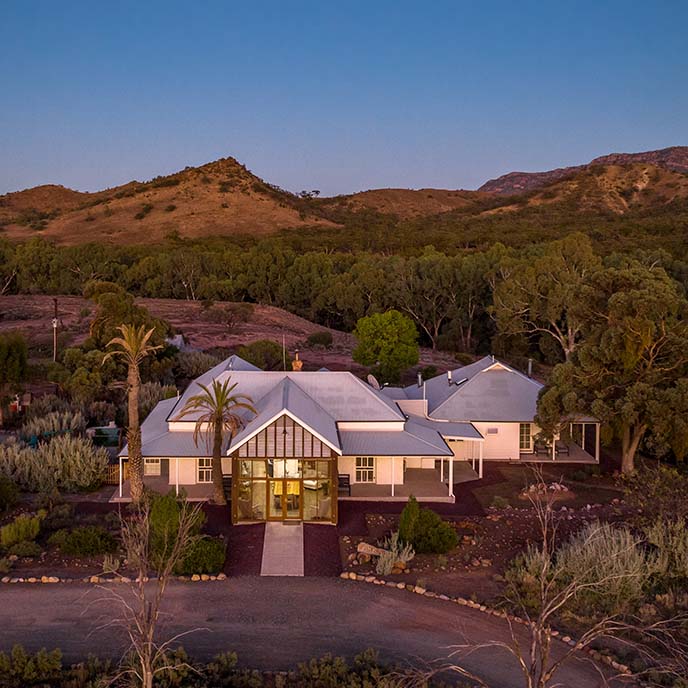
With 60,000 acres and just 5 rooms Arkaba’s rustically chic homestead is an exclusive yet quintessentially Australian experience offering guests classic country hospitality while exploring the outback. Find out more »
Fast Facts
LOCATION
Flinders Ranges is the largest mountain range in South Australia, which starts approximately 200 km north-west of Adelaide. The discontinuous ranges stretch for over 430 km from Port Pirie to Lake Callabonna. The Flinders Ranges National Park is some 450km north of Adelaide.
CLIMATE
The Flinders Ranges generally enjoy clear sunny days all year round. This results in cool winters with many frosty nights. Light snow has been recorded on the tallest peaks. Summers are characteristically hot and dry but extreme heat is rare. Most of the area receives an average of 250 to 300mm of rain a year. The maximum of around 350mm falls in a small area centred around Wilpena Pound. Most of the rain falls during the winter months but the falls from summer thunderstorms and monsoonal influences can be very significant in some years.